Finding Your Perfect Fit: The Art of Ring Sizing
There is nothing quite like the magic of trying on a new piece for the first time and having it feel like it was made just for you. To ensure your new piece feels as gorgeous as it looks, finding the right size is a very important first step.
Many jewellery lovers accidentally order the wrong size the first time, mostly because there is often less than a millimetre of difference between sizes. And while precision is key, finding your perfect fit is actually lemon squeezy. Think of it as a quick, essential step to ensure your new treasure sits comfortably on your hand for years to come. Whether you are treating yourself or choosing a forever piece, this guide will help you find your fit, and shop with total confidence.
How Should It Feel?
Your ring should slide on smoothly but meet a tiny bit of resistance at the knuckle so it stays secure. Once it’s on, it should sit comfortably without spinning excessively.
A well-fitted ring doesn't just feel better, it also protects the craftsmanship of the piece. A ring that is too small can put stress on the ring over time, and a ring that is too large has the potential to slip off.
Tips for a Flawless Measurement
Your fingers are surprisingly dynamic! To get the most "true" reading, keep these factors in mind:
The Afternoon Glow: Measure your finger in the late afternoon or evening. Our hands tend to be slightly smaller in the morning, and we want to ensure the ring is comfortable all day long.
The Goldilocks Zone: Avoid measuring immediately after exercise or when you’re feeling particularly cold or dehydrated, as your finger size can fluctuate by up to two sizes in these conditions.
The Wide Band Rule: If you are falling in love with a wider band design, they naturally feel a bit more snug. I recommend adding half a size to your measurement to ensure a comfortable fit.
How to Measure Your Size
To keep your sizing as accurate as possible, I recommend these methods:
The At-Home Sizer
For the best at-home accuracy, you can purchase a plastic ring sizer gauge directly from my website. It’s a simple, accurate, and reusable tool that takes the guesswork out of the process.
The Comparison Method
If you already have a ring that fits your intended finger perfectly, you can compare using a dedicated app like Ring Size by Jason Withers or a print out ring sizing chart. These will help you find the exact Inside Diameter or ring size. While it is tempting to grab a ruler plz don’t, it’s much less accurate and can lead to incorrect sizing.
Professional Sizing
For very special or high-investment pieces, such as engagement rings, wedding bands, or wide statement bands, professional sizing by a local jeweller can be helpful if it is available to you. This is especially useful if you are unsure, between sizes, or choosing a ring that cannot be easily resized.
The Paper Strip Method
This is a handy backup if you do not have a ring sizer, but it is less precise than using a proper sizing tool. Avoid string, as it can stretch and give an inaccurate result.
Step by step:
Cut a strip of paper around 10 cm long.
Wrap it around the finger where the ring will sit.
Pull it so it feels comfortably snug.
Mark where the paper overlaps.
Measure the strip flat in millimetres.
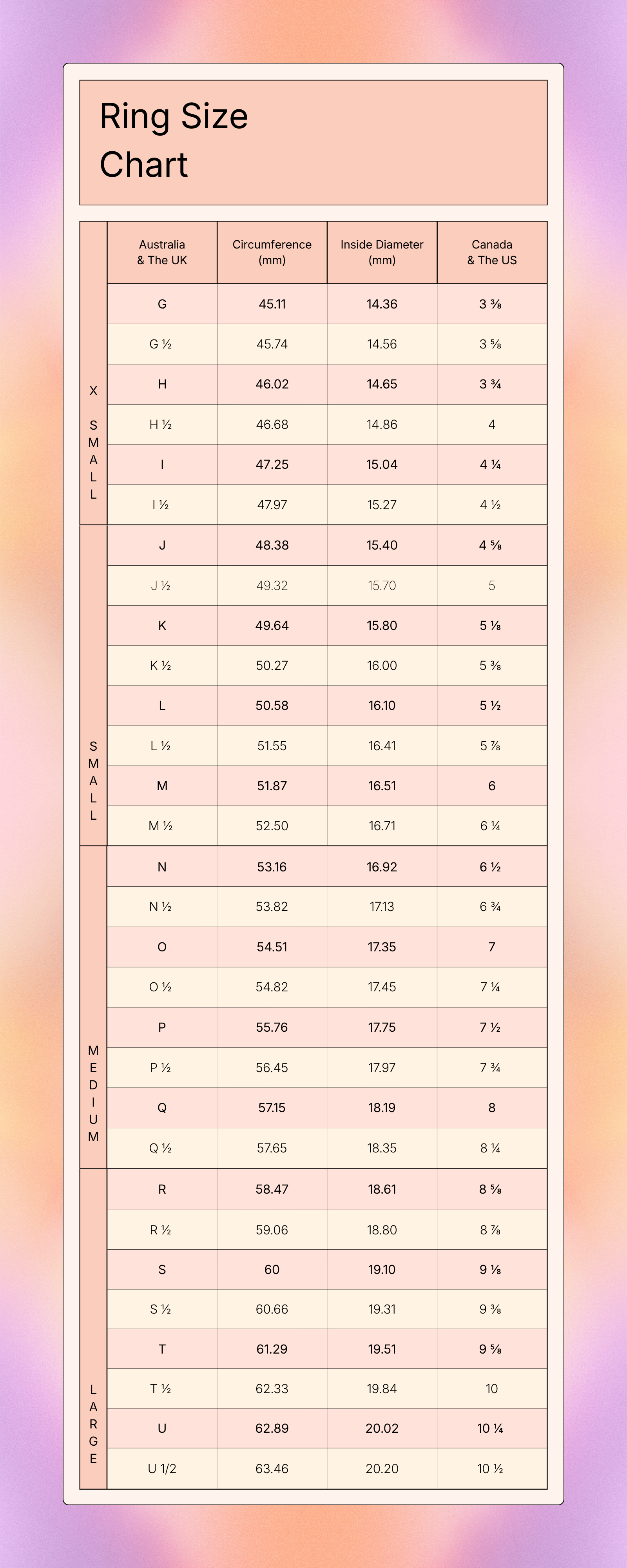
Check the chart below to find your closest size.
Understanding the System
In Australia and the UK, ring sizes are measured using an alphabetic system, including half sizes.
If you know your US size, or have measured your finger’s diameter or circumference in millimetres, use the chart below to find your Aussie size.